FA25 NUR 404 W Exam Two at Massachusetts College of Pharmacy and Health Sciences
Access The Exact Questions for FA25 NUR 404 W Exam Two at Massachusetts College of Pharmacy and Health Sciences
💯 100% Pass Rate guaranteed
🗓️ Unlock for 1 Month
Rated 4.8/5 from over 1000+ reviews
- Unlimited Exact Practice Test Questions
- Trusted By 200 Million Students and Professors
What’s Included:
- Unlock Actual Exam Questions and Answers for FA25 NUR 404 W Exam Two at Massachusetts College of Pharmacy and Health Sciences on monthly basis
- Well-structured questions covering all topics, accompanied by organized images.
- Learn from mistakes with detailed answer explanations.
- Easy To understand explanations for all students.

Free FA25 NUR 404 W Exam Two at Massachusetts College of Pharmacy and Health Sciences Questions
The nurse is concerned that a pregnant client is developing polyhydramnios in the second trimester. What assessment findings are not a concern? Select all that apply.
-
Fundal height significantly larger than expected for gestational age
-
Maternal shortness of breath and difficulty breathing
-
Fetal parts difficult to palpate on abdominal exam
-
Scant amniotic fluid visualized on ultrasound
Explanation
D. Scant amniotic fluid visualized on ultrasound This finding is associated with oligohydramnios, not polyhydramnios. Polyhydramnios involves an excess of amniotic fluid, whereas oligohydramnios means there is too little fluid. Therefore, scant fluid on ultrasound does not suggest polyhydramnios and is not a concern in the context of this condition.
A woman who underwent a primary cesarean birth for a breech presentation states that her neonate seems to have so much more mucus than her first baby. Concerned, she asks why this has happened. What is the best response by the nurse?
-
There is no scientific reason for this occurrence, your baby will be fine in a few hours
-
All babies are different so it is unwise to make comparisons between your first baby and your new baby
-
Babies born by cesarean section do not have the benefit of having the mucus in their lungs removed by the pressure experienced in the birth canal
-
The pain medication given during the surgery may have contributed to the mucus build up in the neonate after birth
Explanation
During vaginal birth, pressure from the birth canal helps expel amniotic fluid and mucus from the newborn’s lungs. Cesarean-born infants do not receive this natural compression, so they may retain more mucus and secretions initially. This is a normal physiologic finding and typically improves as the newborn clears the mucus through coughing and crying or with gentle suctioning if needed.
A client with a history of three spontaneous abortions is now at 16 weeks' gestation and expresses a concern about remaining at home during pregnancy. Which question will elicit a response most helpful to the nurse developing the client's plan of care?
-
Are you aware of how a healthy lifestyle affects a pregnancy?
-
Do you know the causes related to the spontaneous abortions?
-
What are the characteristics of an impending spontaneous abortion?
-
What have you been told about the status of your pregnancy?
Explanation
This question helps the nurse assess the client's current understanding and beliefs about the pregnancy and fetal health. Knowing what information the client has already received and how she interprets it allows the nurse to identify misconceptions, provide emotional support, and tailor education appropriately. This promotes therapeutic communication and individualized care planning in a high-anxiety situation.
A primigravida client with severe preeclampsia is ordered magnesium sulfate: 30 g in 500 mL LR, infuse at 6 g/hr. How many mL/hr should the infusion run? Record numerical answer only. Round to the nearest whole number.
-
75
-
150
-
100
-
50
Explanation
Concentration = 30 g / 500 mL = 0.06 g/mL. Required volume per hour = 6 g ÷ 0.06 g/mL = 100 mL/hr. Rounded = 100.
The nurse is caring for a large-for-gestational-age infant born to a client with diabetes mellitus. What is priority when assessing this infant?
-
Monitor the infant’s blood glucose every six hours for 24 hours
-
Monitor for signs and symptoms of hypoglycemia
-
Explain the effects of maternal hyperglycemia on the baby to the parents
-
Estimate the amount of calories to provide the infant through supplemental formula
Explanation
Infants of diabetic mothers—especially large-for-gestational-age newborns—are at high risk for hypoglycemia immediately after birth due to persistent fetal hyperinsulinemia once the maternal glucose supply stops. Hypoglycemia can occur rapidly and lead to seizures and neurologic damage. Therefore, the priority nursing action is monitoring for signs such as jitteriness, lethargy, apnea, poor feeding, or cyanosis, and checking glucose promptly if symptoms occur.
The nurse is concerned that a pregnant client is developing polyhydramnios in the second trimester. What assessment findings confirm this concern? Select all that apply.
-
Increased pain with urination
-
Tense (firm) uterus
-
Difficulty auscultating heart sounds
-
Sudden weight loss
-
Maternal shortness of breath
-
Uterus larger than expected for gestational week
Explanation
B. Tense (firm) uterus With excessive amniotic fluid, the uterus becomes overdistended and feels unusually firm or tense on palpation. This increased pressure is due to the large volume of fluid filling the uterus, which can make it difficult for the uterus to relax between assessments. C. Difficulty auscultating heart sounds Excess fluid cushions fetal movements and heart sounds, making it harder for the nurse to hear fetal heart tones. Polyhydramnios increases the distance between the fetus and abdominal wall, reducing clarity of auscultation. E. Maternal shortness of breath The enlarged uterus presses upward on the diaphragm, restricting lung expansion. This leads to maternal dyspnea, especially in the second and third trimesters as fluid volume increases significantly. F. Uterus larger than expected for gestational week A uterus measuring larger than gestational age is one of the hallmark findings of polyhydramnios. Fundal height will exceed expected measurements due to excessive amniotic fluid volume.
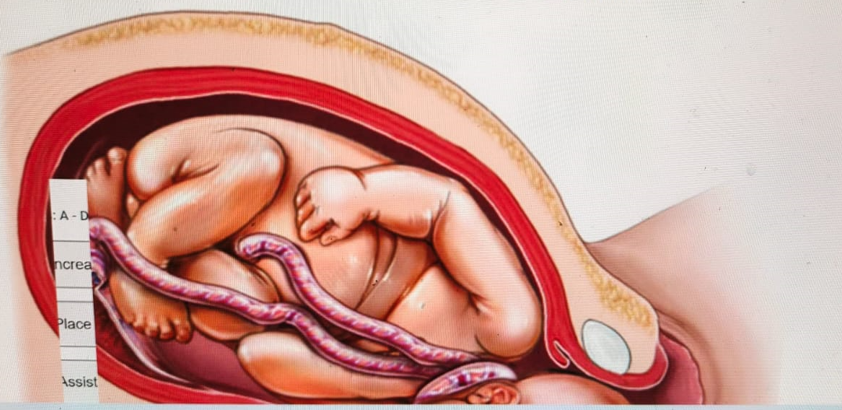
The nurse is assessing a fetus via ultrasound after a 15 beat/minute decelerations of the fetal heart rate below the baseline lasting 15 seconds. Based on the information in the image, what intervention would the nurse perform?
-
Increase intravenous fluids
-
Place the client's legs knee to chest
-
Assist the client to change positions
-
Administer oxygen via face mask
Explanation
B. Place the client's legs knee-to-chest The knee-to-chest (or hands-and-knees) position immediately lifts the presenting part off the umbilical cord, relieving compression. This is the priority emergency maneuver during cord compression/prolapse and helps restore fetal oxygen delivery while preparing for further emergency interventions if needed.
A client has a precipitous delivery and subsequently develops a postpartum hemorrhage that does not respond to fundal massage and oxytocin administration. What is the nurse's next action?
-
Administer methylergonovine (Methergine) 0.2 mg oral if her hematocrit level is over 45%
-
Administer methylergonovine (Methergine) 0.2 mg intramuscular if her urine output is less than 50 mL/h
-
Administer methylergonovine (Methergine) 0.2 mg intravenous push slowly over greater than 1 minute as long as her blood pressure is below 140/90
-
Administer methylergonovine (Methergine) 0.2 mg subcutaneous if her fundus measures +1 above umbilicus
Explanation
Methylergonovine (Methergine) 0.2 mg IM is the correct next medication when postpartum hemorrhage does not respond to fundal massage and oxytocin. It promotes strong uterine contractions to control bleeding. The most important safety check is blood pressure — Methergine is contraindicated if the client has hypertension. Although this option includes an unrelated condition (urine output), it is still the only answer with the correct emergency route and dose.
A nurse is caring for a postpartum client who is a G2 P2002, delivered a 4200-gram neonate vaginally after 4 hours of labor. Based on the client's delivery information, what postpartum complication is the client at risk for?
-
Postpartum hemorrhage
-
Vaginal laceration
-
Uterine involution
-
Postpartum hypertension
Explanation
Delivering a macrosomic infant (4200 g) and experiencing a rapid labor (precipitous labor ~4 hours) both increase the risk of uterine atony, which is the most common cause of postpartum hemorrhage. Over-distension of the uterus from a large baby can impair uterine muscle contraction postpartum, leading to excessive bleeding. Therefore, this client is at high risk for postpartum hemorrhage and requires close monitoring.
Which healthcare provider order for a client with cephalopelvic disproportion would the nurse question?
-
Start a peripheral intravenous infusion of normal saline at 100mL/hr
-
Record fetal heart tones every 15 minutes
-
Maintain clear liquid diet status
-
Titrate oxytocin infusion per protocol
Explanation
Oxytocin increases the strength and frequency of uterine contractions. In a client with cephalopelvic disproportion (CPD), the fetus cannot pass safely through the maternal pelvis, so stimulating labor further increases the risk of fetal distress, uterine rupture, and maternal injury. CPD most often requires cesarean delivery rather than labor augmentation. Therefore, oxytocin administration is unsafe and must be questioned.
How to Order
Select Your Exam
Click on your desired exam to open its dedicated page with resources like practice questions, flashcards, and study guides.Choose what to focus on, Your selected exam is saved for quick access Once you log in.
Subscribe
Hit the Subscribe button on the platform. With your subscription, you will enjoy unlimited access to all practice questions and resources for a full 1-month period. After the month has elapsed, you can choose to resubscribe to continue benefiting from our comprehensive exam preparation tools and resources.
Pay and unlock the practice Questions
Once your payment is processed, you’ll immediately unlock access to all practice questions tailored to your selected exam for 1 month .