C960 Discrete Mathematics II
Access The Exact Questions for C960 Discrete Mathematics II
💯 100% Pass Rate guaranteed
🗓️ Unlock for 1 Month
Rated 4.8/5 from over 1000+ reviews
- Unlimited Exact Practice Test Questions
- Trusted By 200 Million Students and Professors
What’s Included:
- Unlock Actual Exam Questions and Answers for C960 Discrete Mathematics II on monthly basis
- Well-structured questions covering all topics, accompanied by organized images.
- Learn from mistakes with detailed answer explanations.
- Easy To understand explanations for all students.

Free C960 Discrete Mathematics II Questions
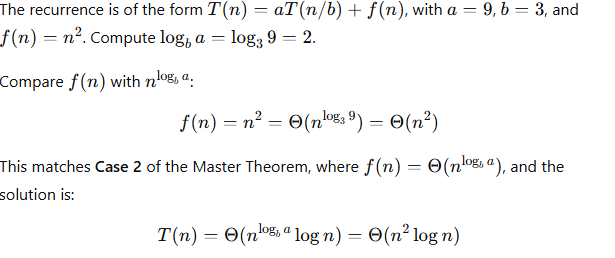
Which of the following is the correct Master Theorem case for T(n) = 9T(n/3) + n²?
-
Case 1 → Θ(n³)
-
Case 2 → Θ(n³ log n)
-
Case 3 → Θ(n²)
-
Case 4 → Θ(n² log n)
Explanation
Which of the following problems is NP-complete?
-
Sorting a list of numbers
-
Finding the shortest path in a graph
-
3-SAT (Boolean satisfiability with clauses of size 3)
-
Checking if a number is prime
Explanation
A problem is NP-complete if it is in NP (its solutions can be verified in polynomial time) and every problem in NP can be reduced to it in polynomial time. Among the options:
Sorting can be done in polynomial time, so it is in P, not NP-complete.
Shortest path can also be solved in polynomial time using Dijkstra’s or Bellman-Ford algorithms.
3-SAT is the canonical NP-complete problem: verifying a satisfying assignment is polynomial-time, and it is known that any NP problem can be reduced to 3-SAT.
Primality checking is in P (AKS algorithm), so it is not NP-complete.
How many Hamiltonian cycles are there in the complete graph K₅?
-
12
-
24
-
60
-
120
Explanation
A Hamiltonian cycle in a graph visits each vertex exactly once and returns to the starting vertex. In a complete graph , every vertex is connected to every other vertex.
In a single-elimination tournament with 16 teams, how many games are played until a champion is determined?
-
15
-
16
-
8
-
31
Explanation
In a single-elimination tournament, each game eliminates exactly one team. Starting with 16 teams, we need to eliminate 15 teams to determine a champion. Since each game eliminates one team, the total number of games played is equal to the number of teams eliminated, which is 16−1=15. This formula holds for any single-elimination tournament: total games = total teams − 1.
How many comparisons does Merge Sort make in the worst case for n=8 elements?
-
8
-
12
-
17
-
20
Explanation
Explanation:
Merge Sort is a divide-and-conquer algorithm that splits the array into two halves, recursively sorts each half, and then merges the sorted halves.
The worst-case number of comparisons can be computed using the recursive formula for comparisons C(n):
where n−1 comparisons are made during the merge step.
For n=8n
1.Split 8 into two halves of 4:C(8)=C(4)+C(4)+7
2.For C(4): split into 2 + 2:C(4)=C(2)+C(2)+3
3.For C(2): split into 1 + 1:C(2)=C(1)+C(1)+1=0+0+1=1
Now compute step by step:
C(4)=1+1+3=5
C(8)=5+5+7=17
What is the output of this greedy algorithm for the coin change problem (coins: 1, 5, 10, 25) when making 67 cents?
-
2 quarters, 1 dime, 1 nickel, 2 pennies
-
2 quarters, 1 dime, 1 nickel, 3 pennies
-
2 quarters, 1 dime, 1 nickel, 7 pennies
-
2 quarters, 1 dime, 1 nickel, 1 penny
Explanation
In the greedy algorithm for the coin change problem, we always choose the largest coin denomination that does not exceed the remaining amount. Starting with 67 cents:
Take 2 quarters (25 × 2 = 50) → remaining 17 cents.
Take 1 dime (10) → remaining 7 cents.
Take 1 nickel (5) → remaining 2 cents.
Take 2 pennies (1 × 2 = 2) → remaining 0 cents.
So the algorithm selects: 2 quarters, 1 dime, 1 nickel, and 2 pennies. This greedy approach gives the optimal result for standard U.S. coin denominations.
Which of the following is a context-free language but NOT regular?
-
{ww | w ∈ {0,1}}
-
{aⁿbⁿcⁿ | n ≥ 0}
-
{wwʳ | w ∈ {a,b}}
-
{aⁿbⁿ | n ≥ 0}
Explanation
A context-free language (CFL) is one that can be generated by a context-free grammar, while a regular language can be recognized by a finite automaton. The language consists of equal numbers of ’s followed by equal numbers of ’s. A finite automaton cannot keep track of how many ’s have been seen, but a pushdown automaton (which has a stack) can—by pushing for each aaa and popping for each . Therefore, this language is context-free but not regular. The other languages either have no dependency between symbol counts (making them regular) or require balancing across three symbols (which is not even context-free).
What is the value of the Ramsey number R(4,3)?
-
7
-
8
-
9
-
10
Explanation
The Ramsey number is the smallest integer such that any graph on vertices contains either a clique of size mmm or an independent set of size nnn. For , it is known that:
This means that in any graph of 9 vertices, either there is a 4-vertex clique or a 3-vertex independent set. With 8 vertices, it is possible to construct a graph that avoids both, so 9 is the minimal number satisfying this property.
How many ways can you distribute 15 identical chapatis to 6 different students if each student gets at least one chapati?
-
5005
-
2002
-
364
-
1365
Explanation
This is a stars and bars problem with the restriction that each student gets at least one chapati. Let be the number of chapatis received by the -th student. We have:
What is the number of onto functions from a set of 10 elements to a set of 3 elements?
-
59049
-
19683
-
270
-
27
Explanation
The number of onto functions from a set of size mmm to a set of size nnn can be calculated using inclusion-exclusion:
Number of onto functions=
How to Order
Select Your Exam
Click on your desired exam to open its dedicated page with resources like practice questions, flashcards, and study guides.Choose what to focus on, Your selected exam is saved for quick access Once you log in.
Subscribe
Hit the Subscribe button on the platform. With your subscription, you will enjoy unlimited access to all practice questions and resources for a full 1-month period. After the month has elapsed, you can choose to resubscribe to continue benefiting from our comprehensive exam preparation tools and resources.
Pay and unlock the practice Questions
Once your payment is processed, you’ll immediately unlock access to all practice questions tailored to your selected exam for 1 month .