C885 Advanced Calculus
Access The Exact Questions for C885 Advanced Calculus
💯 100% Pass Rate guaranteed
🗓️ Unlock for 1 Month
Rated 4.8/5 from over 1000+ reviews
- Unlimited Exact Practice Test Questions
- Trusted By 200 Million Students and Professors
What’s Included:
- Unlock Actual Exam Questions and Answers for C885 Advanced Calculus on monthly basis
- Well-structured questions covering all topics, accompanied by organized images.
- Learn from mistakes with detailed answer explanations.
- Easy To understand explanations for all students.

Free C885 Advanced Calculus Questions
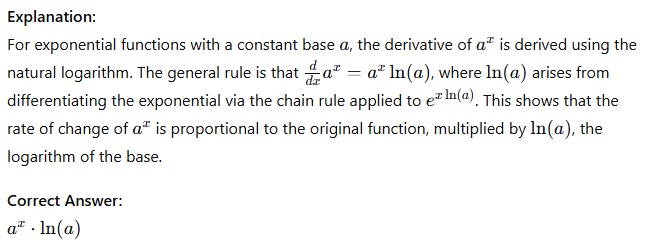
According to the power rule, what is the derivative of a function in the form of ax, where aaa is a constant?
-
x⋅ax−1
-
x⋅ln(a)
-
ax⋅ln(a)
-
ln(a)
-
ax
Explanation
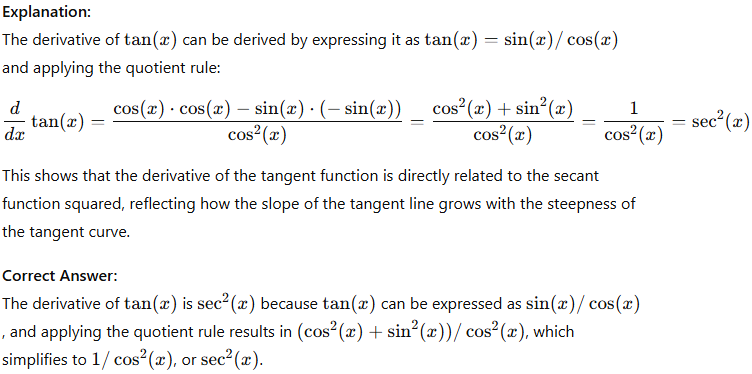
Explain the relationship between the derivative of tan(x) and the secant function. Why is the derivative of tan(x) equal to sec2(x)?
-
The derivative of tan(x) is sec2(x) because tan(x) is the reciprocal of cot(x), and the derivative of cot(x) is −csc2(x).
-
The derivative of tan(x) is sec2(x) because the integral of sec2(x) is tan(x).
-
The derivative of tan(x) is sec2(x) because tan(x) can be expressed as sin(x)/cos(x), and applying the quotient rule results in (cos2(x) + sin2(x))/cos2(x), which simplifies to 1/cos2(x), or sec2(x).
-
The derivative of tan(x) is sec2(x) because it is a fundamental trigonometric identity.
Explanation
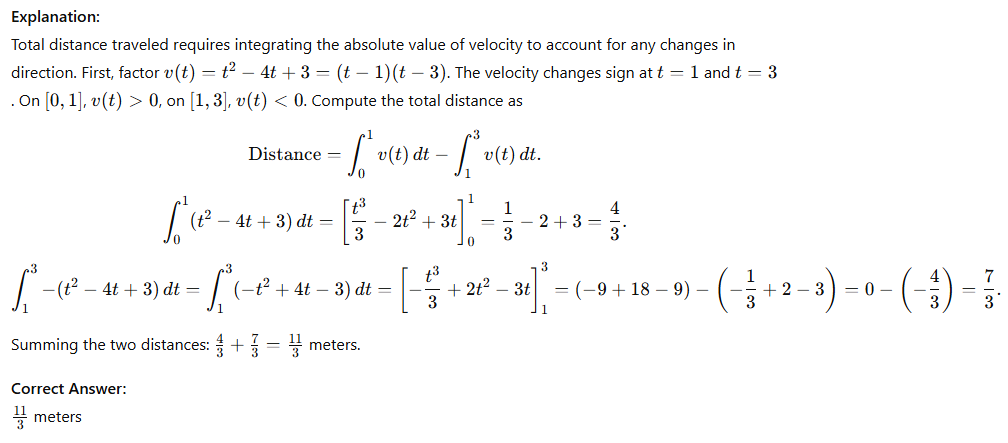
A particle moves along a straight line with velocity v(t) = t2 − 4t + 3 m/s. Calculate the total distance traveled by the particle from t = 0 to t = 3 seconds.
-
11/3 meters
-
5/3 meters
-
1 meter
-
0 meters
Explanation
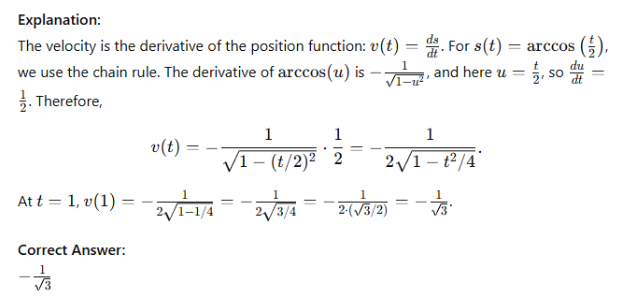
A particle's position is given by s(t) = arccos(t/2). What is the particle's velocity at t = 1?
-

-

-

-

Explanation
Explain in your own words why the power rule for differentiation 
-
The power rule is derived from the limit definition of the derivative and represents the instantaneous rate of change of xn
-
The power rule is an arbitrary mathematical rule with no underlying justification.
-
The power rule is based on the product rule of differentiation.
-
The power rule is only applicable for integer values of n.
Explanation
Explanation:
The power rule works because it can be derived directly from the limit definition of a derivative, which calculates the instantaneous rate of change of a function. By expanding (x + h)n using the binomial theorem and then taking the limit as h→0, the terms simplify to nxn−1. This rule applies not only to integer exponents but also to real numbers, providing a simple and consistent way to find the derivative of any power function without repeatedly using the limit process.
Correct Answer:
The power rule is derived from the limit definition of the derivative and represents the instantaneous rate of change of xn.
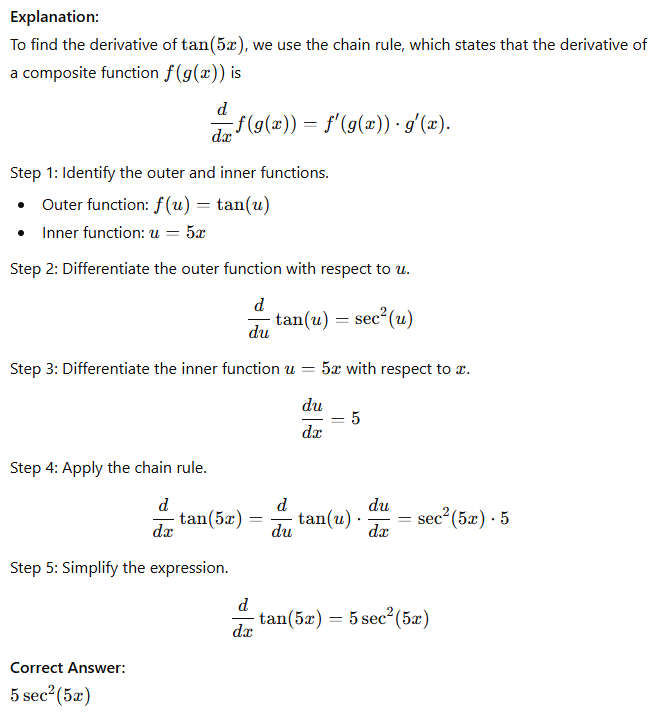
What is most nearly the derivative of tan(5x)?
-
5sec2(5x)
-
5sec2(5x)tan(x)
-
sec2(5x)
-
5csc2(5x)
Explanation
According to the power rule, what factor multiplies x when finding the derivative of xn?
-
n + 1
-
n − 1
-
x
-
n
Explanation
Explanation:
The power rule for differentiation states that the derivative of xn is nx n−1. This means the exponent nnn becomes the coefficient that multiplies the resulting expression. Therefore, the factor that multiplies x when differentiating xn is simply n, taken directly from the original exponent.
Correct Answer:
n
Which best describes the relationship between velocity, displacement & acceleration?
-
velocity is change in position divided by time, displacement is change in acceleration divided by time
-
velocity is equal to position times acceleration
-
velocity is equal to position times acceleration
-
velocity is change in position divided by time, acceleration is change in velocity divided by time
Explanation
Explanation:
In physics and calculus, velocity is defined as the rate of change of position (displacement) with respect to time, while acceleration is defined as the rate of change of velocity with respect to time. This hierarchical relationship shows how motion is analyzed at different levels: position describes where an object is, velocity describes how fast and in what direction the object is moving, and acceleration describes how the velocity changes over time. Understanding these relationships is essential for studying motion and dynamics.
Correct Answer:
velocity is change in position divided by time, acceleration is change in velocity divided by time
Which quantity is equal to the derivative of the velocity with respect to time?
-
Instantaneous velocity
-
Instantaneous acceleration
-
Average velocity
-
Average acceleration
Explanation
Explanation:
The derivative of velocity with respect to time measures how velocity changes over time, which is precisely the definition of acceleration. When considering an instantaneous moment, this derivative gives the instantaneous acceleration, indicating the rate at which an object’s speed or direction changes at that specific point in time. This concept is fundamental in kinematics and dynamics, linking motion to the forces acting on an object.
Correct Answer:
Instantaneous acceleration
Why does the dominated convergence theorem require domination by an integrable function rather than merely bounded by a constant?
-
Constant bounds suffice only on finite measure spaces
-
Without integrability of the dominator, exceptional sets of arbitrary measure can ruin convergence
-
Pointwise convergence alone fails on unbounded domains without domination
-
The theorem would otherwise apply to all monotone sequences
Explanation
Explanation:
The dominated convergence theorem (DCT) ensures that one can interchange the limit and integral for a sequence of functions fn→f if the fn are dominated by an integrable function g. Simply being bounded by a constant is insufficient on sets of infinite measure, because the integral of a constant over an infinite measure space can diverge. Integrability of the dominator guarantees that any “large” deviations in the sequence fn are controlled in measure and contribute finitely to the integral, preventing the limit from being invalidated by sets of large measure where the functions are significant.
Correct Answer:
Without integrability of the dominator, exceptional sets of arbitrary measure can ruin convergence
How to Order
Select Your Exam
Click on your desired exam to open its dedicated page with resources like practice questions, flashcards, and study guides.Choose what to focus on, Your selected exam is saved for quick access Once you log in.
Subscribe
Hit the Subscribe button on the platform. With your subscription, you will enjoy unlimited access to all practice questions and resources for a full 1-month period. After the month has elapsed, you can choose to resubscribe to continue benefiting from our comprehensive exam preparation tools and resources.
Pay and unlock the practice Questions
Once your payment is processed, you’ll immediately unlock access to all practice questions tailored to your selected exam for 1 month .