CHM 130 Introduction to Chemistry at Arizona College of Nursing
Access The Exact Questions for CHM 130 Introduction to Chemistry at Arizona College of Nursing
💯 100% Pass Rate guaranteed
🗓️ Unlock for 1 Month
Rated 4.8/5 from over 1000+ reviews
- Unlimited Exact Practice Test Questions
- Trusted By 200 Million Students and Professors
What’s Included:
- Unlock Actual Exam Questions and Answers for CHM 130 Introduction to Chemistry at Arizona College of Nursing on monthly basis
- Well-structured questions covering all topics, accompanied by organized images.
- Learn from mistakes with detailed answer explanations.
- Easy To understand explanations for all students.

Free CHM 130 Introduction to Chemistry at Arizona College of Nursing Questions
What is the name of the following compound: HOCH₂CH₂CH₂CH₂OH
-
1,4-butanediol
-
1,4-butanol
-
1,3-butanol
-
1,1-butanediol
Explanation
Correct Answer: A. 1,4-butanediol
Explanation of Correct Answer:
The compound HOCH₂CH₂CH₂CH₂OH has four carbon atoms (butane backbone) and two hydroxyl (–OH) groups located on the first and fourth carbons. The “diol” suffix indicates the presence of two hydroxyl groups, and the numbers specify their positions. Therefore, its correct IUPAC name is 1,4-butanediol. The other names are incorrect because they either misplace or reduce the number of hydroxyl groups present in the molecule.
For an endothermic reaction, energy is absorbed when the reaction runs in
-
The reverse direction
-
The forward direction
-
Either direction
-
Neither direction
Explanation
Correct Answer: B. The forward direction
Explanation of Correct Answer:
In an endothermic reaction, energy (usually in the form of heat) is absorbed from the surroundings as the reaction proceeds in the forward direction. This means the products have higher energy than the reactants. The absorption of energy is necessary to break existing bonds before new ones form. In the reverse (exothermic) direction, the reaction would release energy instead of absorbing it.
What is the group that distinguishes alcohols from other classes of compounds?
-
Carboxyl
-
Amide
-
Carbonyl
-
Hydroxy
Explanation
Correct Answer: Hydroxy
Explanation of Correct Answer:
The hydroxy group (–OH) is the functional group that characterizes alcohols. It consists of an oxygen atom bonded to a hydrogen atom and attached to a carbon atom in the molecule. This group enables hydrogen bonding, which significantly influences alcohols’ solubility and boiling points. In contrast, carboxyl groups (–COOH) define carboxylic acids, amide groups (–CONH₂) define amides, and carbonyl groups (C=O) are found in aldehydes and ketones.
What structural characteristic is shared by the aldehydes and the ketones?
-
They both are straight chain compounds.
-
Aldehydes and ketones both contain a carbonyl carbon.
-
Both of these compound classes have as the smallest compound a 5-carbon skeleton.
-
Aldehydes and ketones have no shared characteristics.
Explanation
Correct Answer: B. Aldehydes and ketones both contain a carbonyl carbon
Explanation of Correct Answer:
Aldehydes and ketones share the presence of a carbonyl group (C=O) as their defining structural feature. In aldehydes, the carbonyl carbon is bonded to at least one hydrogen atom, while in ketones, it is bonded to two carbon atoms. This carbonyl group is responsible for their similar chemical reactivity and polarity, making it the key shared structural characteristic between the two classes.
Name this structure using IUPAC nomenclature:
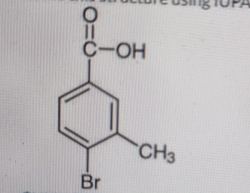
-
1-bromo-2-methyl-4-benzoic acid
-
1-carboxyl-4-bromo-5-methanoic acid
-
3-methyl-4-bromobenzoic acid
-
4-bromo-3-methylbenzoic acid
Explanation
Correct Answer: C. 3-methyl-4-bromobenzoic acid
Explanation of Correct Answer:
The parent structure is benzoic acid (a benzene ring with a –COOH group). That –COOH group is automatically carbon 1. We then number the ring to give the lowest possible locants to the substituents. Doing this places a methyl group on carbon 3 and a bromo group on carbon 4, giving the name 3-methyl-4-bromobenzoic acid. The other names either misnumber the ring or use nonstandard parent names.
An active site that makes a conformation change to accommodate a substrate is associated with which enzyme action mechanism?
-
Allosteric Theory
-
Zymogen Theory
-
Lock-and-Key Theory
-
Induced Fit Theory
Explanation
Correct Answer: D. Induced Fit Theory
Explanation of Correct Answer:
The Induced Fit Theory proposes that when a substrate binds to an enzyme, the enzyme’s active site changes shape slightly to better accommodate the substrate. This dynamic adjustment enhances binding precision and catalytic efficiency. In contrast, the Lock-and-Key Theory suggests a rigid fit between enzyme and substrate, while Allosteric Theory involves regulation at a site other than the active site, and Zymogen Theory pertains to inactive enzyme precursors that require activation.
What are the three parts of an amino acid?
-
Phosphate group, amino group, and organic R group
-
Phosphate group, sugar, and organic R group
-
Carboxyl group, amino group, and organic R group
-
Phosphate group, amino group, and carboxyl group
Explanation
Correct Answer: C. Carboxyl group, amino group, and organic R group
Explanation of Correct Answer:
An amino acid contains three essential components: an amino group (–NH₂), a carboxyl group (–COOH), and an organic R group (side chain). The amino group acts as a base, the carboxyl group acts as an acid, and the R group determines the specific chemical properties of each amino acid. Together, these groups allow amino acids to link via peptide bonds to form proteins.
What is the name of the following organic compound: CH₃CH=CHCH₂CH₃
-
2-hexene
-
2-pentene
-
3-pentene
-
2-pentadiene
Explanation
Correct Answer: B. 2-pentene
Explanation of Correct Answer:
The structure CH₃CH=CHCH₂CH₃ is a five-carbon chain with one double bond, so the parent name is pentene. Number the chain from the end closest to the double bond. The double bond starts between carbons 2 and 3, so the correct IUPAC name is 2-pentene. 3-pentene is not used because numbering must give the lowest possible locant for the double bond. Choices with six carbons or multiple double bonds are not correct.
What number would be used to indicate the double bond position in the IUPAC name for CH₃–CH₂–CH=CH–CH₃
-
3
-
2
-
1
-
4
Explanation
Correct Answer: B. 2
Explanation of Correct Answer:
In IUPAC nomenclature, the carbon chain is numbered from the end nearest the double bond to give the lowest possible number to the double bond. For CH₃–CH₂–CH=CH–CH₃, numbering from the left gives the double bond between carbons 2 and 3, making the correct name pent-2-ene. If numbered from the right, it would be pent-3-ene, which has a higher locant and is therefore incorrect.
According to Le Chatelier's Principle, predict the equilibrium shift for the following reaction:
A + B ⇌ C + D + Heat
-
Decreasing A shifts the reaction to the left
-
Increasing D shifts the reaction to the right
-
Decreasing B shifts reaction to the right
-
Increasing temperature shifts the reaction to the right
Explanation
Correct Answer: A. Decreasing A shifts the reaction to the left
Explanation of Correct Answer:
Le Chatelier’s Principle says that if a stress is applied to a system at equilibrium, the system will shift to oppose that change. If you decrease A (a reactant), the system will try to replace A by producing more A. It can only do that by shifting to the left, favoring the reverse reaction (making more A and B from C and D).
How to Order
Select Your Exam
Click on your desired exam to open its dedicated page with resources like practice questions, flashcards, and study guides.Choose what to focus on, Your selected exam is saved for quick access Once you log in.
Subscribe
Hit the Subscribe button on the platform. With your subscription, you will enjoy unlimited access to all practice questions and resources for a full 1-month period. After the month has elapsed, you can choose to resubscribe to continue benefiting from our comprehensive exam preparation tools and resources.
Pay and unlock the practice Questions
Once your payment is processed, you’ll immediately unlock access to all practice questions tailored to your selected exam for 1 month .