C646 Trigonometry and Precalculus
Access The Exact Questions for C646 Trigonometry and Precalculus
💯 100% Pass Rate guaranteed
🗓️ Unlock for 1 Month
Rated 4.8/5 from over 1000+ reviews
- Unlimited Exact Practice Test Questions
- Trusted By 200 Million Students and Professors
What’s Included:
- Unlock Actual Exam Questions and Answers for C646 Trigonometry and Precalculus on monthly basis
- Well-structured questions covering all topics, accompanied by organized images.
- Learn from mistakes with detailed answer explanations.
- Easy To understand explanations for all students.

Free C646 Trigonometry and Precalculus Questions
Explain the significance of '+ C' in the indefinite integral ∫du = u + C.
-
'+ C' represents the initial value of the function.
-
'+ C' represents the derivative of u.
-
'+ C' represents the constant of integration, accounting for the fact that the derivative of a constant is zero, thus any constant could be part of the original function.
-
'+ C' represents the error term in the integration.
-
'+ C' is only necessary for definite integrals
Explanation
When integrating an expression such as ∫du, the result represents a family of antiderivatives rather than a single function. Since the derivative of any constant is zero, adding any constant to the antiderivative still produces the same derivative. The term “+ C” ensures that all possible antiderivatives are represented, because indefinite integrals do not specify initial conditions or starting values. This constant accounts for the full set of functions that share the same derivative.
Which of the following statements best describes the convergence behavior of the power series representation of cos(x)?
-
The power series converges only for x values between -1 and 1.
-
The power series diverges for all x values except x = 0.
-
The power series converges for all real numbers
-
The power series converges only for x = 0.
Explanation
The power series for cos(x) is given by the infinite series ∑ (-1)ⁿ x^(2n) / (2n)!. Because the factorial in the denominator grows much faster than the powers of x in the numerator, the series converges for all real numbers. This property is a result of the ratio test, which shows that the limit of the ratio of successive terms approaches zero for any finite x. Therefore, the cosine series converges everywhere on the real line.
According to the limit definition, what is the formula for the derivative f'(x) that represents the instantaneous rate of change of a function f(x)?
-
f'(x) = lim (n→0) [f(x+n) + f(x)] / n
-
f'(x) = lim (n→0) [f(x+n) - f(x)] / n
-
f'(x) = lim (n→∞) [f(x+n) - f(x)] / n
-
f'(x) = lim (n→0) [f(x) - f(x+n)] / n
Explanation
The derivative of a function at a point is defined as the limit of the average rate of change over an interval n as n approaches zero. The correct structure is the difference quotient [f(x+n) − f(x)] divided by n, describing how the function changes over a shrinking interval. Only this expression matches the formal limit definition of the derivative.
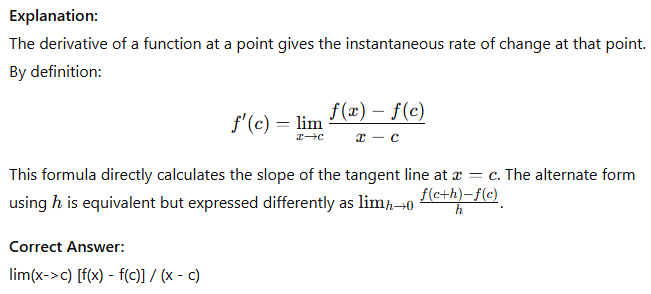
According to the limit definition, what expression represents the derivative of a function f(x) at a specific point 'c'?
-
lim(x->c) [f(x) + f(c)] / (x + c)
-
lim(x->0) [f(x) - f(c)] / (x - c)
-
lim(x->c) [f(x) - f(c)] / (x - c)
-
lim(h->0) [f(x + h) - f(x)] / h
Explanation
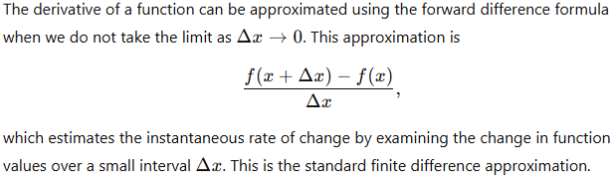
If we don't take the indicated limit for the first derivative of f(x) at a point, the approximate relation for the derivative df(x)/dx is _____.
-
(f(x−Δx)+f(x)) / (Δx)
-
(f(x+Δx)−f(x)) / (Δx)
-
(f(x+Δx)+f(x)) / (Δx)
-
(f(x−Δx)−f(x)) / (Δx)
Explanation
A population of bacteria grows exponentially according to the function P(t) = 3^t, where t is time in hours. Using calculus, determine the instantaneous rate of growth of the bacteria population at t = 2 hours.
-
6
-
ln(9)
-
9
-
3 ln(2)
-
9 ln(3)
Explanation
The instantaneous rate of growth of an exponential function P(t) = a^t is found by differentiating P(t) with respect to t, which gives dP/dt = a^t ln(a). Here, P(t) = 3^t, so dP/dt = 3^t ln(3). Evaluating at t = 2 gives dP/dt = 3² ln(3) = 9 ln(3). This represents the rate at which the bacteria population is growing at exactly t = 2 hours.
What is the right answer among the following?
-
Logistic growth follows an S-shaped curve that levels out at carrying capacity.
-
Neither a nor b is correct.
-
Exponential growth follows an S-shaped curve that levels out at carrying capacity.
-
Both a and b are correct.
Explanation
Logistic growth models populations or processes that start slowly, grow rapidly, and then level off as they approach a carrying capacity, producing the well-known S-shaped (sigmoidal) curve. Exponential growth, however, increases without bound and does not level off. Therefore, only the statement describing logistic growth leveling at carrying capacity is correct.
Explain why cos(π/3) equals 1/2 using the unit circle definition of cosine.
-
The angle π/3 is a special angle whose cosine is memorized as 1/2 without geometric justification
-
Cosine is defined as the ratio of the opposite side to the hypotenuse, which simplifies to 1/2 at π/3.
-
Cosine is defined as the ratio of the hypotenuse to the adjacent side, which simplifies to 1/2 at π/3.
-
On the unit circle, π/3 corresponds to a point where the y-coordinate (sine value) is 1/2.
-
On the unit circle, π/3 corresponds to a point where the x-coordinate (cosine value) is 1/2.
Explanation
On the unit circle, each angle corresponds to a point (x, y), where x is the cosine of the angle and y is the sine of the angle. For the angle π/3, the corresponding point on the unit circle is (1/2, √3/2). Therefore, cos(π/3), which is the x-coordinate of this point, equals 1/2. This directly follows from the unit circle definition of cosine and applies to all angles measured in standard position.
A car is moving forward with a velocity of 20 m/s. If the driver applies the brakes, creating a constant acceleration of -5 m/s², what will happen to the car's speed?
-
The car's speed will remain constant.
-
The car's speed will increase.
-
The car's speed will decrease.
-
The car will immediately stop.
Explanation
Explanation:
Acceleration is the rate of change of velocity. A negative acceleration (deceleration) means the velocity is decreasing over time. Since the car experiences a constant acceleration of -5 m/s², its speed will gradually decrease until it potentially reaches zero if braking continues long enough.
Correct Answer:
The car's speed will decrease.
The derivative of csc θ is
-
-csc² θ
-
-csc θ tan θ
-
Sec θ tan θ
-
-csc θ cot θ
Explanation
The derivative of the cosecant function, csc θ, is found using the chain rule and the reciprocal identity csc θ = 1/sin θ. Differentiating gives d/dθ[csc θ] = -csc θ cot θ. This formula is standard and shows that the rate of change of csc θ depends on both csc θ itself and cot θ.
How to Order
Select Your Exam
Click on your desired exam to open its dedicated page with resources like practice questions, flashcards, and study guides.Choose what to focus on, Your selected exam is saved for quick access Once you log in.
Subscribe
Hit the Subscribe button on the platform. With your subscription, you will enjoy unlimited access to all practice questions and resources for a full 1-month period. After the month has elapsed, you can choose to resubscribe to continue benefiting from our comprehensive exam preparation tools and resources.
Pay and unlock the practice Questions
Once your payment is processed, you’ll immediately unlock access to all practice questions tailored to your selected exam for 1 month .